Risenshine! Here is digest of signals harvested on 2026-07-14.
Markets
International - 07/13
Germany (EWG):
-0.6267% -1.4579% MoM
France (EWQ):
-0.4663% -2.0109% MoM
United Kingdom (EWU):
-0.515% +0.3246% MoM
Italy (EWI):
-0.1981% +0.9853% MoM
Italy (EWI):
-0.1981% +0.9853% MoM
Spain (EWP):
-0.8579% +1.0978% MoM
Netherlands (EWN):
-1.4976% -4.2392% MoM
Chile (ECH):
-2.0398% -5.1541% MoM
Belgium (EWK):
-0.3426% -3.3948% MoM
Germany (EWD):
-1.371% -2.3987% MoM
Australia (EWO):
-1.4377% -1.9461% MoM
China Large-Cap (FXI):
-0.1195% -4.7565% MoM
Japan (EWJ):
-1.9355% -1.4246% MoM
India (INDA):
-1.0345% -0.9541% MoM
Taiwan (EWT):
-4.0588% -4.2211% MoM
Hong Kong (EWH):
-0.9302% -2.6063% MoM
Singapore (EWS):
-0.6637% +8.6791% MoM
Indonesia (IDX):
+0.8721% -7.9576% MoM
Malaysia (EWM):
+0.2552% -0.9366% MoM
Saudi Arabia (KSA):
-0.3758% -3.6354% MoM
Arab Emirates (UAE):
-1.6436% -3.2828% MoM
Qatar (QAT):
+0.1094% -4.0702% MoM
Israel (EIS):
-1.1477% -6.874% MoM
Kuwait (KWT):
-0.9975% -3.6865% MoM
Africa (AFK):
-2.1065% -8.3871% MoM
Commodities - 07/13
gold (GLD):
-2.6206% -7.419% MoM
silver (SLV):
-3.3179% -17.8194% MoM
US oil (USO):
+8.3625% -2.8215% MoM
platinium (PPLT):
-1.6926% -9.589% MoM
agriculture (DBA):
-0.1801% +5.0796% MoM
carbon (KRBN):
+0.7522% +0.6587% MoM
copper (CPER):
-0.1316% -4.3127% MoM
gaz (UNG):
-2.1698% -9.2738% MoM
corn (CORN):
+0.4005% +4.0925% MoM
weat (WEAT):
-0.253% +4.9689% MoM
uranium (URA):
-5.2362% -15.2726% MoM
lithium (LIT):
-2.8761% -16.4605% MoM
Favorites - 07/13
Adobe (ADBE):
+3.1166% +11.7513% MoM
AMD (AMD):
-4.2123% -2.3517% MoM
Microsoft (MSFT):
+1.5295% -2.1938% MoM
Nvidia (NVDA):
-3.522% -4.1986% MoM
Oracle (ORCL):
-6.4704% -31.7172% MoM
Axon (AXON):
-3.3174% +23.4246% MoM
Amazon (AMZN):
+0.803% +0.5243% MoM
Alibaba (BABA):
+0.0178% -0.1777% MoM
JD (JD):
+2.4113% +0.6974% MoM
ARM (ARM):
-7.5451% -27.5264% MoM
Intel (INTC):
-6.118% -19.3493% MoM
Mu (MU):
-4.3194% -13.8779% MoM
Qualcom (QCOM):
-2.7384% -16.6795% MoM
Marvel (MRVL):
-7.752% -29.5746% MoM
Apple (AAPL):
+0.6311% +7.0474% MoM
Lowe (LOW):
-1.857% -5.6724% MoM
Sectors - 07/13
SP500 (SPY):
-0.7656% -0.7498% MoM
healthcare (XLV):
+0.3544% +5.5726% MoM
finance (XLF):
+0.6462% +4.6863% MoM
real-estate (XLRE):
+0.5624% -0.6446% MoM
semi-conductors (SOXX):
-4.77% -11.9087% MoM
aerospace (ITA):
-1.6774% -0.9899% MoM
reit (RWR):
+0.6674% +1.4515% MoM
transportation (XTN):
-0.4771% -1.764% MoM
agriculture (MOO):
+0.6299% +4.1012% MoM
clean energy (QCLN):
-3.8241% -15.6644% MoM
Gainers
Twin Vee PowerCats Co. Common Stock +394.5%
Twin Vee PowerCats Co is a designer, manufacturer, and marketer of recreational and commercial power boats to use for fishing, diving and water skiing, and commercial activities in...
SOBR Safe, Inc. Common Stock +151.3%
Sobr Safe Inc is a hardware and software company. The Company integrates proprietary software, SOBRsafeTM, with its patented touch-based personal alcohol awareness tracking product...
Losers
BNB Plus Corp. Common Stock -65.2%
BNB Plus Corp focuses on digital asset treasury management of BNB. The group is unlocking institutional-grade access to the Binance ecosystem, delivering non-directional yield stra...
QTREX Quantum Ltd. Warrant -65%
QTREX Quantum Ltd designs and manufactures cryogenic interconnect systems used in quantum computing systems. Its activities focus on technologies related to manufacturing, material...
Business
Geopolitical Implications of Rising Tensions in the Strait of Hormuz and US-Iran Relations in 2026
In the news:
- Iran’s supreme leader vows revenge for killing of his father after Trump threatens to launch thousands of missiles if Tehran tries to assassinate him [Fortune]
- Strait jacket: Wall Street is worried President Trump has no good options for ending the war with Iran [Fortune]
- Trump hints at a ‘dead man’s switch’ if Iran assassinates him. But Vice President JD Vance would make the call [Fortune]
- Iran says Strait of Hormuz is closed, claims it struck vessel using ‘unauthorized route’ [Fortune]
- MORE THREATS... [Associated Press]
🗺 Background:
- The Strait of Hormuz is a strategic chokepoint through which roughly 21 million barrels of oil per day transited in 2025, representing approximately 21% of global petroleum liquids.
- U.S.-Iran relations deteriorated dramatically in 2026 following the assassination of Iran's former supreme leader and a series of retaliatory threats between President Donald Trump and Iranian authorities.
- The region has witnessed periodic naval confrontations, with tensions escalating this year after U.S. forces were accused of supporting actions that disrupted ceasefire negotiations in the wider Middle East.
- Both Iran and international actors including the United States frequently reference the potential closure of the strait as a critical global economic and security threat.
🎩 Key stakeholders:
- President Donald Trump, who has issued public threats of large-scale missile retaliation if Iran attempts assassination plots.
- Iran’s current supreme leader, who has vowed revenge for the assassination of his father and declared the closure of the Strait of Hormuz.
- Vice President JD Vance, who may assume command and potential launch authority if power is transferred following Trump’s incapacitation.
- Key institutions include the United States Central Command (CENTCOM), Iranian Revolutionary Guard Corps, and major oil companies depending on the strait's passage.
💡 News facts:
- On July 11, 2026, Iran's supreme leader publicly threatened revenge after his father’s killing and reaffirmed that the Strait of Hormuz is considered closed by Iran, risking further escalation with the U.S. https://fortune.com/2026/07/11/iran-supreme-leader-revenge-trump-missiles-assassination-attempt-ceasefire/
- On July 11, 2026, Fortune reported that Iran claims to have struck a vessel using an 'unauthorized route' as Iran and Oman discussed managing the strait’s security. https://fortune.com/2026/07/11/iran-strait-of-hormuz-closed-vessel-strike-unauthorized-route/
- On July 12, 2026, the Associated Press reported that Iran again considers the Strait of Hormuz closed following a warning shot at a vessel, further jeopardizing the fragile ceasefire with the United States. https://apnews.com/article/iran-united-states-trump-khamenei-funeral-533b52cf249314ba1d9b5f9a30b1ca43
- On July 11, 2026, Fortune detailed Trump’s warning of a potential 'dead man’s switch,' suggesting Vice President JD Vance would determine posthumous retaliation policy if Trump were assassinated. https://fortune.com/2026/07/11/trump-dead-mans-switch-iran-assassination-vice-president-jd-vance/
➡ Potential consequences:
- Near-term risks include immediate disruption of global energy markets, with crude oil prices likely to spike if tanker passage is halted at the Strait of Hormuz.
- A breakdown of the ceasefire between U.S. and Iran could trigger direct military exchanges and further destabilize the regional security architecture.
- Medium-term effects may include an accelerated global decoupling from Persian Gulf oil, increased militarization in the region by U.S. and allied naval forces, and escalated cyber and covert actions.
- Continued escalation raises the possibility of invoking emergency collective security mechanisms by U.S. allies and dramatic impacts on global shipping insurance rates.
Read online: https://fortune.com/2026/07/11/iran-supreme-leader-revenge-trump-missiles-assassination-attempt-ceasefire/ https://fortune.com/2026/07/11/iran-strait-of-hormuz-closed-vessel-strike-unauthorized-route/ https://apnews.com/article/iran-united-states-trump-khamenei-funeral-533b52cf249314ba1d9b5f9a30b1ca43
Analysis of Price Disparities Between Crude Oil and Refined Products Amid Falling Global Oil Demand
🗺 Background:
- Global oil demand has declined significantly in recent months, leading to a drop in crude oil prices.
- Despite lower crude oil prices, refined products such as gasoline and diesel remain expensive in many regions.
- The divergence in pricing is attributed to varying regional consumption patterns and refining bottlenecks.
- Inflationary pressures and supply chain issues continue to impact fuel prices independently of crude oil movements.
🎩 Key stakeholders:
- Major oil-producing countries, including OPEC members, influence crude oil supply to stabilize prices.
- Refining companies and downstream operators are key players in setting refined product prices.
- U.S. consumers and industries are heavily impacted stakeholders due to high gasoline usage.
- Global economic institutions and analysts are monitoring the effects of persistent price gaps.
💡 News facts:
- Fortune reported on July 11, 2026, that while global oil demand fell, U.S. gasoline use actually increased in the second quarter of 2026, contrasting the global trend. https://fortune.com/2026/07/11/global-oil-demand-crude-prices-gasoline-diesel-refined-products-inflation/
- The same source confirmed that gasoline and diesel prices remained elevated in July 2026 despite reduced crude prices. https://fortune.com/2026/07/11/global-oil-demand-crude-prices-gasoline-diesel-refined-products-inflation/
➡ Potential consequences:
- In the near-term, consumers in regions with rising demand—such as the U.S.—may continue experiencing high fuel costs.
- The medium-term could see increased pressure on refiners to expand capacity and improve efficiency to address supply-demand imbalances.
- Policy makers may intervene with targeted subsidies or regulatory changes if price disparities persist.
- Disjointed price movements between crude and refined products could distort inflation readings and economic forecasts.
The Environmental and Economic Impacts of Rapid Turnover in Chinese Electric Vehicles
🗺 Background:
- Chinese electric vehicles (EVs) have an average operational lifespan of just 1.8 years, according to a 2026 Bloomberg analysis.
- This rapid turnover in EVs is significantly shorter than typical consumer electronics, such as cell phones, reflecting fast-paced technological innovation.
- Concerns have emerged over the environmental footprint of short-lived EVs, including battery waste and carbon emissions from manufacturing.
🎩 Key stakeholders:
- Major Chinese EV manufacturers such as BYD and NIO drive technological advances and rapid product cycles.
- Chinese government agencies set policies influencing EV adoption, production, and environmental standards.
- Technology firms and battery suppliers directly impact the pace of EV innovation and recycling infrastructure.
💡 News facts:
- According to a July 12, 2026 Bloomberg report, Chinese EVs currently average just 1.8 years on the road, less than the lifespan of cell phones.
➡ Potential consequences:
- Short usage periods may increase pressure on recycling and battery disposal systems in the near-term.
- Ongoing rapid turnover could undermine sustainability goals by increasing waste and emissions over the medium term.
- Consumers and manufacturers may face higher lifecycle costs due to short product lifespan.
Factors Driving Persistent US Inflation: AI Adoption, El Niño, and Trade Policy in 2026
🗺 Background:
- US inflation remains persistently high in 2026, driven by a combination of technological, environmental, and policy events.
- The widespread adoption of artificial intelligence is contributing to price pressures across multiple sectors.
- A severe 'Godzilla' El Niño is impacting agricultural and energy markets with adverse weather effects.
- Ongoing trade tensions, including tariffs introduced under the Trump administration, continue to disrupt supply chains.
🎩 Key stakeholders:
- Goldman Sachs has emerged as a leading voice in forecasting AI-driven inflationary pressures in the US.
- Major technology companies scaling AI adoption, such as Nvidia and Microsoft, are reshaping labor and input costs.
- US government policymakers are navigating complex trade dynamics following the reintroduction of tariffs.
- Agribusinesses and energy producers are directly affected by El Niño-related weather disruptions and fuel shortages.
💡 News facts:
- Goldman Sachs forecasts AI adoption will boost US core inflation by 50 basis points by the end of 2026, a fivefold increase compared to other nations, published 2026-07-11. https://www.businessinsider.com/us-inflation-outlook-economy-ai-memory-software-prices-goldman-sachs-2026-7#article
- Fortune reported on 2026-07-11 that businesses are still adjusting prices in response to Trump-era tariffs, over a year since their introduction, exacerbating the inflation outlook. https://fortune.com/2026/07/11/inflation-outlook-godzilla-el-nino-ai-boom-trump-tariffs-fuel-crunch-ukraine-war-prices/
➡ Potential consequences:
- Consumers may face continued increases in essentials such as food and energy through late 2026.
- Business investment decisions could remain cautious due to ongoing cost volatility and supply chain uncertainties.
- Global competitiveness of US firms could be affected by inflation outpacing that of key international peers.
- Central banks, including the Federal Reserve, may sustain restrictive monetary policy for longer than previously anticipated.
The Socio-Economic Impact of the 2026 FIFA World Cup on US Cities and Businesses
In the news:
- The ‘Soccer Capital of America’ is now gunning for the Soccer Capital of the World (Cup) [Fortune]
- All the celebrities spotted cheering on their favorite teams at the World Cup [Business Insider]
- World Cup tourists basking in the wonders of Target are stuffing their suitcases with toothpaste and melatonin [Business Insider]
- The Raising Cane’s co-CEO has seen those World Cup fans praising the chicken and sauce. He’s ‘pretty grateful’ to have ‘chicken fanatics’ worldwide [Fortune]
- I took a 95-year-old camera to the World Cup. Everyone thought I was crazy. [Business Insider]
🗺 Background:
- The 2026 FIFA World Cup is being hosted by cities across the United States, marking the tournament’s return to North America for the first time since 1994.
- Major American cities like Kansas City, Miami, and Los Angeles have made significant investments in infrastructure to accommodate fans and teams.
- The expected influx of millions of international visitors is projected to boost consumer spending and hospitality revenue nationwide.
- The event has generated enthusiasm from both local populations and global tourists, reflecting soccer’s growing popularity in the U.S.
🎩 Key stakeholders:
- Kansas City officials and civic leaders have dedicated $700 million over more than a decade to build out soccer and sports facilities.
- U.S. retailers like Target and restaurant chains such as Raising Cane’s are seeing direct economic impacts from global fans.
- Major celebrities including Tom Cruise and David Beckham are participating and raising the event’s media profile.
- FIFA organizers and local U.S. businesses, from hotels to big box stores, are critically positioned to benefit from the tournament’s spending surge.
💡 News facts:
- Kansas City has invested $700 million in infrastructure and is now vying for global recognition as a premier soccer city, according to a July 11, 2026 Fortune article. https://fortune.com/2026/07/11/kansas-city-soccer-capital-america-world-cup-fifa/
- World Cup tourists are clearing out inventory at big-box stores like Target, buying large quantities of essentials and souvenirs, as reported by Business Insider on July 11, 2026. https://www.businessinsider.com/world-cup-fans-shopping-clearing-out-american-big-box-stores-2026-7#article
- Raising Cane's co-CEO AJ Kumaran has received global requests for their chicken after World Cup visitors' videos went viral, according to Fortune on July 10, 2026. https://fortune.com/2026/07/10/raising-canes-ceo-aj-kumaran-world-cup-fans-american-food/
- Celebrities such as Tom Cruise and David Beckham attended the 2026 FIFA World Cup, boosting its profile, as noted by Business Insider on July 11, 2026. https://www.businessinsider.com/photos-celebrities-cheering-2026-world-cup#article
➡ Potential consequences:
- Short-term, U.S. cities could experience record-high retail and hospitality spending, straining logistics and supply chains in host zones.
- Medium-term, successful hosting may permanently elevate the status of select cities such as Kansas City within global sports and tourism networks.
- U.S. food, retail, and leisure brands could see increased international demand owing to exposure from World Cup fans and viral content.
- Local governments might face increased pressure to sustain infrastructure investment and support for major international events.
Top Voices:
Read online: https://fortune.com/2026/07/10/raising-canes-ceo-aj-kumaran-world-cup-fans-american-food/ https://fortune.com/2026/07/11/kansas-city-soccer-capital-america-world-cup-fifa/ https://www.businessinsider.com/photographed-world-cup-with-1930-camera-2026-7#article https://www.businessinsider.com/photos-celebrities-cheering-2026-world-cup#article https://www.businessinsider.com/world-cup-fans-shopping-clearing-out-american-big-box-stores-2026-7#article
Science News
Resource Optimization in Quantum Algorithms for Breaking Internet Cryptography
In the news:
🗺 Background:
- Shor's algorithm, proposed in 1994, enables efficient factorization of large numbers, posing a threat to RSA-based internet cryptography.
- RSA-2048 is widely used to secure online communications and is considered safe against classical computers.
- Recent research has focused on resource optimization to reduce the quantum computational effort required to break RSA-2048.
- Advances in quantum hardware and error correction have shifted theoretical timelines for practical cryptanalysis.
🎩 Key stakeholders:
- Academic institutions such as MIT, University of Waterloo, and Google Quantum AI lead research in quantum algorithm optimization.
- Government agencies like the US National Institute of Standards and Technology (NIST) oversee post-quantum cryptography standardization.
- Leading quantum hardware companies include IBM, IonQ, and Rigetti Computing.
- Cybersecurity firms and internet infrastructure providers are key stakeholders in adoption of quantum-resistant encryption.
💡 News facts:
- On July 10, 2026, Next Big Future reported dramatic reductions in the estimated quantum resources required for Shor's algorithm to target RSA-2048, reflecting progress over the past 18 months. https://www.nextbigfuture.com/2026/07/improved-research-and-roadmaps-for-quantum-to-crack-main-internet-security-rsa-2048.html
- Estimates still require multi-day runtimes and billions of physical qubits to theoretically break RSA-2048 as of July 2026, according to published roadmaps. https://www.nextbigfuture.com/2026/07/improved-research-and-roadmaps-for-quantum-to-crack-main-internet-security-rsa-2048.html
➡ Potential consequences:
- In the near term, dramatic resource reductions may accelerate demand for transitioning to quantum-resistant cryptography.
- Medium-term consequences include increased urgency for global institutions and companies to update security standards and protocols.
- Advancements could lead to the development of new cybersecurity threats and incentives for nation-state actors to invest in quantum capabilities.
- Potential financial risks for companies using legacy encryption if quantum breakthroughs achieve practical cryptanalysis sooner than expected.
Investment Trends and Hardware Requirements in Commercial Quantum Computing Startups
In the news:
🗺 Background:
- Commercial quantum computing startups are attracting large investments as they aim to reach viability with fewer qubits.
- Quantum hardware remains costly and complex, with companies racing to lower the barrier for practical implementation.
- Breakthroughs in qubit requirements could make quantum advantages accessible to broader industrial segments.
- Recent funding rounds reflect a growing confidence in startups that promise scalable, application-specific quantum machines.
🎩 Key stakeholders:
- Oratomic, a quantum computing startup, is a major new entrant aiming to build a viable quantum computer with just 20,000 qubits.
- Leading venture capital firms are actively financing hardware-focused quantum startups, highlighting institutional interest.
- Research partnerships with academic institutions continue to underpin advances in superconducting and trapped-ion qubit technologies.
- Executive teams with backgrounds from Google Quantum AI and IBM Quantum are shaping technical direction in these companies.
💡 News facts:
- On July 10, 2026, Oratomic announced it raised $300 million in new funding to build a quantum computer needing only 20,000 qubits. https://techcrunch.com/2026/07/10/oratomic-raises-300m-to-build-a-viable-quantum-computer-that-needs-only-20k-qubits/
- Oratomic claims their new architecture reduces common hardware overhead by 40%, targeting commercial use cases within three years. https://techcrunch.com/2026/07/10/oratomic-raises-300m-to-build-a-viable-quantum-computer-that-needs-only-20k-qubits/
- The round was led by Quantum Ventures with participation from FutureCap and AtomBridge, marking one of the largest quantum hardware investments in 2026. https://techcrunch.com/2026/07/10/oratomic-raises-300m-to-build-a-viable-quantum-computer-that-needs-only-20k-qubits/
➡ Potential consequences:
- Significant investment may accelerate the timeline for commercially viable quantum computing solutions, impacting AI and cryptography sectors in the near-term.
- If Oratomic's approach proves feasible, it could shift hardware requirements industry-wide and lower costs for enterprise quantum adoption.
- Medium-term, successful hardware reductions may catalyze a new wave of quantum startups and stimulate demand for specialized engineering talent.
- Established tech companies may intensify acquisition strategies to secure emerging quantum hardware capabilities.
Scaling Robotic Production: Tesla's Supplier Constraints for Optimus Gen 3
In the news:
🗺 Background:
- Tesla is accelerating the development of its Optimus Gen 3 humanoid robot, announced as part of its long-term automation strategy.
- Robotic manufacturing at Tesla aims to reduce labor costs and address workforce shortages at scale.
- Supplier scalability is a critical factor for mass production of robotics and achieving operational targets.
- Recent procurement strategies reflect Tesla’s intent to move from limited pilot runs to large-scale production.
🎩 Key stakeholders:
- Tesla Inc. is the primary developer and buyer of the Optimus Gen 3 humanoid robot.
- Key suppliers provide parts critical to robotic assembly, including actuators, sensors, and batteries.
- Elon Musk, CEO of Tesla, is directly overseeing the scaling of Optimus Gen 3 production.
- Next Big Future is one of the main sources reporting on Tesla supplier directives.
💡 News facts:
- On July 10, 2026, reports confirmed Tesla instructed suppliers to scale up Optimus Gen 3 parts production to 1,000 units per week by September 2026【1:0†
- By the end of 2026, Tesla’s suppliers have been directed to reach a target capacity of 2,000 to 2,500 units per week for Optimus Gen 3 components【1:0†
➡ Potential consequences:
- In the near term, suppliers facing rapid scaling requirements may experience logistical bottlenecks and capital strain.
- If Tesla achieves targeted production, Optimus Gen 3 could become the world’s first mass-produced general-purpose robot by early 2027.
- Medium-term supplier growth constraints could impact the feasibility of Tesla’s automation roadmap and profitability targets.
- Increased production could accelerate competitive pressure on robotics manufacturers globally.
Economic Assessment of Crop Losses Attributable to Global Warming
🗺 Background:
- Global warming is reducing crop yields worldwide due to increased heat, drought, and changing precipitation patterns.
- Economic estimates suggest crop losses from climate change already exceed $20 billion annually.
- The agricultural sector is especially vulnerable to climate-driven disruptions, impacting both food security and rural economies.
- Crop losses attributed to global warming are expected to rise further as global temperatures continue climbing.
🎩 Key stakeholders:
- Farmers and agricultural workers are directly affected by declining yields and economic losses.
- National governments and policy makers must address both food security risks and compensation for affected producers.
- Agricultural research institutions and scientists play key roles in assessing impacts and developing adaptation strategies.
- Insurance companies are increasingly exposed to risk from climate-related crop loss claims.
💡 News facts:
- A recent analysis indicates that global warming is already causing more than $20 billion in annual crop losses, with substantial impacts projected for major food-producing regions (published 2026-07-10).
➡ Potential consequences:
- Near-term consequences may include higher food prices and increased volatility in agricultural markets.
- Medium-term impacts could involve reduced food security, particularly for vulnerable populations and low-income countries.
- Long-term ramifications may include shifts in crop viability by region and heightened pressure for climate adaptation investments.
- Ongoing losses threaten rural livelihoods and could intensify migration and social instability in affected regions.
AI-Assisted Formalization of Mathematical Proofs: Insights from Fermat's Last Theorem
🗺 Background:
- Fermat's Last Theorem was first conjectured by Pierre de Fermat in 1637 and proven by Andrew Wiles in 1994.
- Formalization of mathematical proofs involves expressing proofs in computer-readable formal logic.
- AI-assisted proof formalization uses algorithms to verify, structure, and sometimes suggest logical steps in complex proofs.
- Interest in using AI for formal mathematics has grown rapidly in the past decade.
🎩 Key stakeholders:
- Andrew Wiles, who proved Fermat's Last Theorem in 1994, is a central figure in the theorem's history.
- New Scientist covered the recent AI-assisted formalization effort in July 2026.
- Institutions involved include research groups specializing in AI for mathematics and event organizers in London.
- Leading mathematicians and computer scientists participated in the 2026 London event.
💡 News facts:
- On July 10, 2026, mathematicians at an event in London reported unexpectedly fast progress in using AI to formalize Fermat's Last Theorem [New Scientist, 2026-07-10].
➡ Potential consequences:
- Near-term, successful AI-assisted formalization may streamline the verification of other major mathematical results.
- Medium-term, the approach could accelerate discovery and validation in related fields like cryptography and complexity theory.
- Broader adoption of AI formalization tools may change peer review and research publishing norms in mathematics.
Culture
No famous painter from the 6th century Middle East is historically documented
"N/A..."
The 6th century Middle East did not have well-documented painters whose works survived or were recorded in historical texts. Artistic expressions were predominantly in the form of architecture, mosaics, and calligraphy rather than individual painters....
Jacob of Serugh
"“Every good tree brings forth good fruit, and a corrupt tree brings forth evil fruit..."
Jacob of Serugh (c. 451–529) was a prominent Syriac Christian bishop and prolific poet-theologian known for his extensive metrical homilies. He greatly influenced Syriac literature and Christian theology in the Middle East during the 6th century....
No famous scientist from the 6th century Middle East is distinctly recorded
"N/A..."
The 6th century Middle East had few documented scientists as the scientific tradition flourished more prominently in later centuries. Scientific knowledge was often preserved and transmitted by scholars but individual scientists from this period are not well-identified....
Khosrow I (Khosrow Anushirvan)
"“Wisdom is the treasure of kings..."
Khosrow I (reigned 531–579) was a Sasanian king of Persia renowned for his administrative reforms and promotion of arts, science, and philosophy. He significantly strengthened the Sasanian Empire and fostered cultural and intellectual exchanges between East and West....
NASA
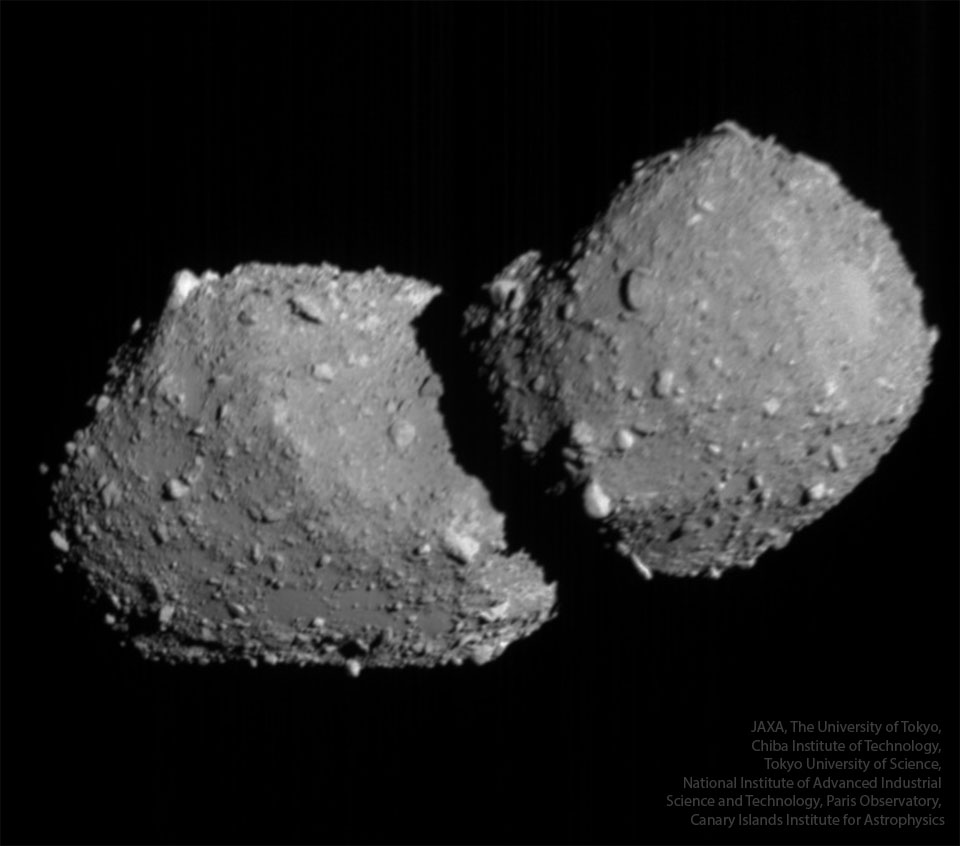
Double Lobed Asteroid Torifune (2026-07-14)
Credits: JAXA, U. of Tokyo, Chiba Tech, Tokyo U. of Science, AIST, Paris Obs., IAC
Credits: JAXA, U. of Tokyo, Chiba Tech, Tokyo U. of Science, AIST, Paris Obs., IAC
Github
Trading tools
QuantAIWorkbench 25 stars #150
AI + quantitative indicators trading analysis workbench...
qtbt 25 stars #151
Research on quantitative trading system based on backtrader framework...
quant_rv 25 stars #152
quant_rv is a quantitative ETF trading strategy based on realized volatility, written in R...
btester 25 stars #153
Python framework optimized for running backtests on multiple asset portfolios...
Sea Vessels
boattracker 0 stars #150
A Web Application that tracks and manages boats...
boatwatch 0 stars #151
Garmin app for Boat-Tracker and Car-Map...
autonomous-vision-boat 0 stars #152
Computer vision for autonomous boat using OpenCV library for tracking and following object...
ReadBoat 0 stars #153
Per-student reading comprehension tracker for teachers...
Air Vessels
Plane-Tracking 1 stars #150
TrackingAndVisualizingPlanes 1 stars #151
Planet_Tracking 1 stars #152
BlackBox 1 stars #153
Plane Tracker...
Imagery
keras-aug 17 stars #150
A library that includes Keras 3 preprocessing and augmentation layers, providing support for various data types such as images, labels, bounding boxes, segmentation masks, and more...
DINOv3-based-Image-Classifier 16 stars #151
A PyTorch implementation of an image classification system based on the DINOv3 (self-DIstillation with NO labels) vision transformer. This project provides a complete training pipe...
TTGA 16 stars #152
[MedIA 2026] Official implementation of TTGA: Test-Time Generative Augmentation for Medical Image Segmentation....
DFCPS 16 stars #153
[ISBI 2024] Semi-supervised Medical Image Segmentation Method Based on Cross-pseudo Labeling Leveraging Strong and Weak Data Augmentation Strategies...
Video
Seedance-2.5-API 431 stars #150
Python wrapper for ByteDance's Seedance 2.5 API — Text-to-Video, Image-to-Video, realistic human faces, native 4K, consistent character generation....
OmniCustom 423 stars #151
Official Implementation of 'OmniCustom: Sync Audio-Video Customization Via Joint Audio-Video Generation Model' ...
VisionReward 420 stars #152
[AAAI 2026] VisionReward: Fine-Grained Multi-Dimensional Human Preference Learning for Image and Video Generation...
World-R1 407 stars #153
[ICML 2026] World-R1: Reinforcing 3D Constraints for Text-to-Video Generation...